où l’on parle encore de dopage

vu les évènements récents du tour, j’en profite pour faire un peu de pub pour le livre de mon frère qui vient de sortir :
l’épreuve du dopage

et, tant qu’à faire, achetez aussi celui-là :
le livre des techniques du son, tome 3
j’ai bien le droit de me faire un peu de pub sur mon blog…


Cardioid bass

A very interesting topic at diyAudio Forum with Earl Geddes and John Kreskovsky, comparing monopole, dipole and cardioid bass responses in a room.


Faut-il traiter acoustiquement ?

Le local d’écoute est l’antépénultième maillon de la chaîne de reproduction sonore, avant l’oreille et le cerveau (ça en jette, non ?). Ceux qui s’y connaissent un peu se désolent du manque d’attention apporté au local. Mais est-ce vraiment nécessaire de traiter le local ? Et pire, mal traité, n’est-ce pas moins bien que pas traité du tout ?

Les études acoustiques ont presque toujours porté sur l’acoustique des salles (grandes) ou sur le traitement des lieux professionnels. Qu’en est-il des salons de Mr et Mme Tout-le-monde ?

Deux papiers importants écrits par des vrais spécialistes apportent un éclairage un peu à contre-courant :

  • Floyd Toole a publié "“Loudspeakers and Rooms for Sound Reproduction – A Scientific Review”, J.Audio Eng. Soc., vol. 54, pp. 451-476 (2006 June)" Extrait : "Any device inserted into a reflected sound path—reflector, absorber, or diffuser—should perform uniformly well at all frequencies above the transition frequency region, say, 200–300 Hz. This is in order to preserve the spectral balance of the loudspeakers, to uniformly attenuate the full spectrum of reflections, and to ensure that the precedence effect is maximally effective", à voir un avant-goût ici et ici. Mais je ne peux que vous conseiller de chercher le papier complet (empruntez-le, volez-le, mais surtout lisez-le)
  • Siegfried Linkwitz a présenté une conf à l’AES à l’automne 2007 que chacun doit lire, c’est ici. Extrait : Reflections generated by the two loudspeakers should be delayed copies of the direct sound to the listener. The delay should be greater than 6 ms. The high frequency content of the reflections should not be intentionally attenuated……The requirement for full spectral content of the reflections rules out the use of frequency dependent absorbers on the room surfaces. The various commercially available foam or fiberglass panels absorb predominantly higher frequencies only and would color the room reflected sound dynamically to where it no longer can be cognitively separated from the direct sound. This then argues for relatively live room acoustics that are determined by the “normal stuff of life” with which the room is filled and decorated, acoustics with which we are intimately familiar as normal.

 En résumé, plutôt plein de meubles que du traitement acoustique ou alors un traitement qui soit efficace sur une large bande (au-dessus de 200Hz) donc au moins 10cm d’épaisseur de laine de verre dense (plus de 50kg par m3), sinon rien. A lire et à méditer….

XOtime

New page

is time alignement on loudspeakers important or not ? Try this new soft


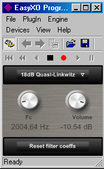
EasyXO

First VST software of Jean Leung

a crossover with various types of filters, it’s now easy to listen and compare :

  • 6 dB/oct
  • 12dB Linkwitz-Riley
  • 18dB Butterwoth with polarity inversion
  • 18dB from JMLC (LeCleac’h)
  • 18dB quasi-Linkwitz proposed by F Brooke
  • 18dB proposed by P Sheinkin
  • 24 dB Linkwitz-Riley

Go to the software page.


Turn me up

une autre initiative contre la peste envahissante du loudnesswar :

http://turnmeup.org/

et aussi justice for audio !

la dynamique vivra Smiley


The Final Cut – suite -

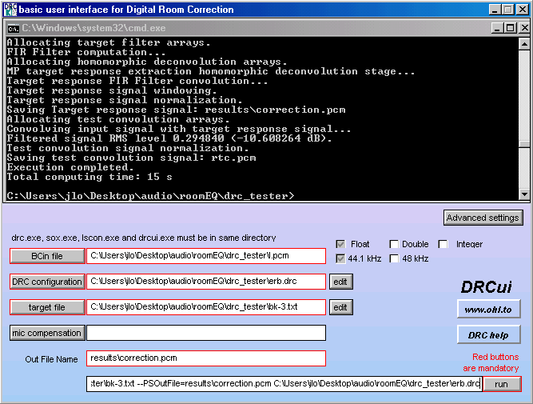
Dans la foulé de Align, j’ai mis à jour The Final Cut avec les mêmes améliorations pour la correction DRC.

The Final Cut est évidemment bien plus puissant mais aussi plus complexe : il ne sert pas à corriger des enceintes et/ou le local mais à comprendre comment les enceintes et le local interagissent. C’est, je crois, un bon outil pour apprendre à paramétrer une correction. Maintenant que l’outil est là, il faut que j’apprenne à bien m’en servir.


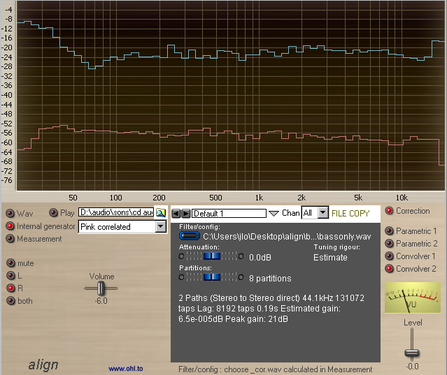
Digital Room Correction for the dummies : Align

No more reason not to have a perfect loudspeakers + room setup, just try this simple software called Align.

In 5 clicks, you measure and correct the amplitude and phase response of your speakers in your room.

Sorry the explanation page here is yet only in french but the soft should be easy enough to use, get it here.


le rouge et le blanc

Puisque je suis dans les petits papiers concernant le vin, je rappelle qu’il existe une petite revue agréable et indépendante : Le Rouge et le Blanc


Etat d’urgence

Encore un bouquin de Michael Crichton : pas très bon, une intrigue cousue avec un élastique, bof et rebof…

Par contre, le thème, écologie et scepticisme, croyances et sciences, est bien abordé dans les annexes avec, en particulier, une bibliographie soignée.

Oubliez donc le livre et contentez-vous des annexes…

Vous pourriez vous rabattre sur l’écologiste sceptique, mais indisponible : tous les exemplaires ont-ils été brulés par les verts ?


Le gout et le pouvoir

J’ai beaucoup apprécié ce livre de Jonathan Nossiter (le réalisateur de Mondovino) : le gout et le pouvoir

Un livre critique sur l’univers du vin, sans complaisance, il m’a rappellé les excellents livres de Guy Renvoisé : c’est bien de sortir un peu des discours habituels. Très agréable à lire, en plus.

Et les compte-rendus de dégustation sont tellement vrais : tout le monde se plante, ça me rassure…


Triple tone in phase audibility

Another update in Phase Audibility software : I added a triple tone, that consists of three sine waves at equal frequency distance, F2-F1=F3-F2.

Now we can easily do the Zwicker phase test, just center the filter frequency to same frequency as generator in triple tone position and listen to phase distortion. At 2kHz, I can hear and ABX differences between various filter types.


Phase audibility update

I’ve been asked if I could add absolute polarity test on phase audibility software, it’s done so try it.


The precedence effect

From Wikipedia :, when two identical sounds (i.e. identical sound waves of the same perceived intensity) originate from two sources at different distances from the listener, the sound created at the closest location is heard (arrives) first. It is also known as "Haas effect" or "law of the first wavefront".

The drawback of this precedence effect for a stereo (or multichannel) setup, is that the phantom image collapses to the nearest speaker (the one heard before).
Can we avoid this ? Maybe…because a very interesting possibility exists : if the second sound has a higher level, the precedence effect can be avoided.

I wanted to check myself what is the needed level, for what frequencies, up to what delay, aso,.. so to know if we can really compensate the precedence effect in an audio system. For this, I did a software so you can play with delay and level and check, for different signals, if really the central image stays stable.
Download here


FIR crossover and convolution

Crossvolver is a new soft that includes a 4 ways FIR crossover with room EQ through DRC :
- each FIR filter is calculated with Uli’s maXO and can be convoluted with your DRC correction, so the filter does both work in one convolution, crossover and DRC
It uses maXO and Convolver

You can download it here, it’s called crossvolver.
Right now, it’s very new and I had no time yet to do a page to explain how it works but you can have a look at its interface on this page


Box diffraction

Another "game" for all DIYers : is box diffraction so audible and what are the best panel dimensions ?
See this new soft here.


REG on audio

I just came across a VERY interesting new article at regonaudio.com :

Audio in modern times, the triumph of rationality, I don’t agree about everything in this article but thanks REG !

Inside are some words about one of the most important test ever done with loudspeakers : the speaker by-pass, a not so well-known experiment by Gradient


The Final Cut (or boost)

TFC is a new software that goes much further than Room Sound : it integrates Speaker simulation, Early reflexions, Modal Response and Room Correction though EQ or DRC. No it’s not another Digital Room Correction, it’s the missing step to understand what DRC should really do. Very new, check it at The Final Cut.


Modal sound

This is a trial to understand what happens with room modes : modes take some time to establish, cannot deal easily with them with Eq, when you move, they also move, etc,…complicated, very complicated !

So listen to your room modes with a headphone and move your walls with your mouse, much easier…

Try this : use pink noise and adjust the room length to have a peak at say 200Hz. Now set generator to bonger also at 200Hz and listen with/without room and change attenuation. Even a small attenuation gives sensible results ! Now try to get same results with the parametric EQ set at 200Hz. Good luck, ….

My first thoughts after some listenings :
- every room treatment is favourable, even small ones, each dB lost in low frequencies on a wall is rewarding and audible ! Because the absorption occurs at each wall reflexion, the effect is multiplied !
- you cannot cancel acoustic modes with graphical Eq. With parametric filters, you need to do it very precisely.

The subject is a bit new for me so any feedback will be much appreciated.

Note : this soft has been integrated in the final cut (see post above) so you won’t find it anymore in the download page.


Bass-reflex : is the vent sounding so poor ?

In a bass-reflex box, sound from the rear of the speaker chassis is re-radiating through the port, Rod Elliot measured values between -10 to -20dB up to 3kHz, about same figures in Borwick’s book. So I did a simple soft to listen if this sound is audible or not. I also added a simulation for the 24dB/oct cutoff of this kind of box, so you can listen if the cutoff and its associated group-delay is audible. Listen with a headphone and not through your favorite bass-reflex box or you may add distortion two times !

Next step would be to add re-radiation from the enclosure through the cone itself (values seem to be in the -20dB range).

The soft is at the download page.